
Reviewed · CITY TOURS
Private Full-Day Muscat City Tour
Muscat’s story comes into focus through its grandest buildings and its most ordinary market stalls. This private tour takes you from the 21-ton Grand Mosque carpet and its 14-meter Swarovski crystal chandelier to the Mutrah fish market, where fresh seafood is bought and sold by local people.
I like the way the day mixes major sights with everyday Muscat, and I like having a private guide and vehicle for a long route that covers several separated parts of the city. The main consideration is the price: at $259 per person, this makes the most sense for people who value privacy, pickup, and a full schedule, especially if group discounts apply.
Key points to know before booking
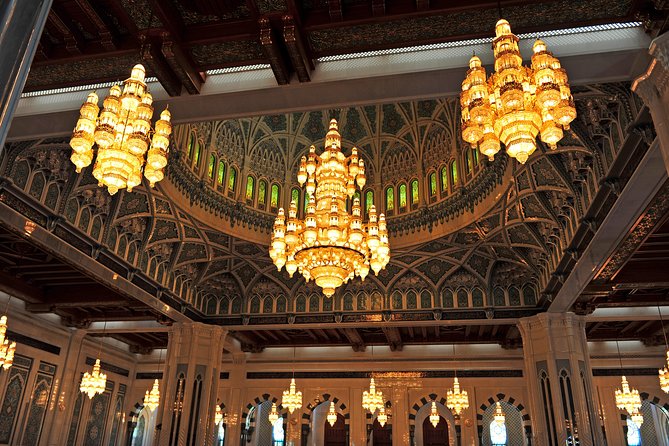
- See the Grand Mosque’s remarkable interior: The main prayer hall holds more than 6,500 worshippers and contains a 21-ton carpet in 28 colors.
- Move from daily life to royal Muscat: The fish and vegetable market gives you a local scene before the palaces and forts of old Muscat.
- Explore Mutrah’s traditional shopping lanes: Allow an hour for Mutrah Souq, one of Oman’s oldest marketplaces.
- Get a private touring day: Only your group participates, with pickup offered and a start time of 8:30 a.m.
- Take in several landmark buildings: The Royal Opera House, Al Alam Palace, Bait Al Zubair Museum, and Mutrah Fort each show a different side of Oman.
- Plan around access and weather: The forts behind Al Alam Palace are picture stops only, and the tour requires good weather.
A full Muscat day from mosque to harbor
This is a city tour built around contrasts. You begin at the Sultan Qaboos Grand Mosque, move through the ministries and embassy district toward Al Qurum Beach, then reach Mutrah’s market and harbor. The afternoon shifts to forts, a royal palace, a cultural museum, and the Royal Opera House.
The schedule lasts about seven to eight hours, beginning at 8:30 a.m. That early start matters. It gives you a better chance of seeing the mosque as planned and leaves enough time for the many stops without turning every visit into a quick photograph.
Because the tour is private, you are not tied to a large group’s pace. You can ask for explanations along the way, spend your full hour in the souq, or keep a stop brief if the heat or your interest level calls for it. The supplied information does not name the individual guide, but the operator is Discover Mazoon Tours Oman.
A few more Muscat trips to weigh up
- From Muscat: Wadi Shab & Bimmah Sinkhole Full-Day Tour
★ 4.8 · 1,862 reviews - Wadi Shab and Bimmah Sinkhole Group Full Day Tour
★ 5.0 · 303 reviews - Full-Day Private Wahiba Sands Desert and Wadi Bani Khalid Tour
★ 5.0 · 291 reviews
Grand Mosque: start with Oman’s grandest interior
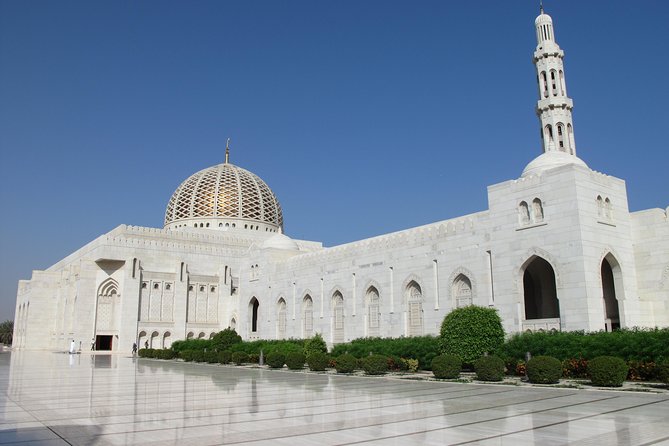
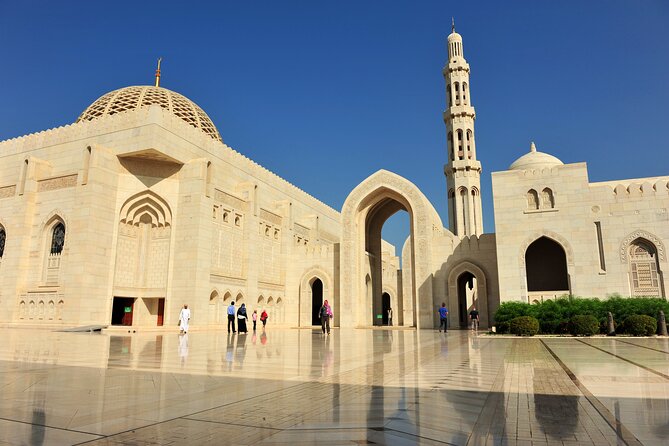
The Sultan Qaboos Grand Mosque is the visual anchor of the morning. It was inaugurated on May 4, 2001, on a large site covering 416,000 square meters, with the mosque complex itself extending over 40,000 square meters.
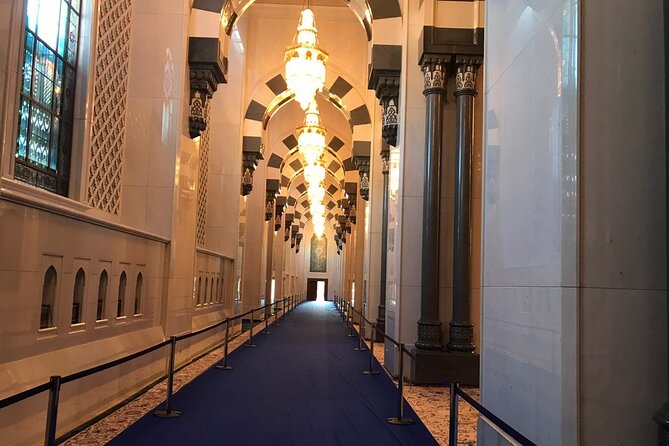
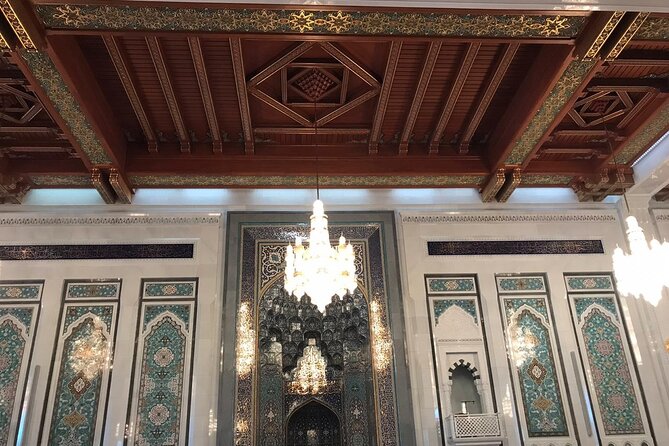
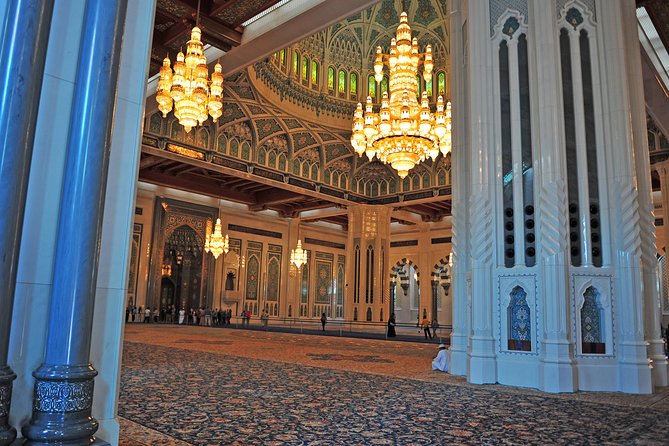
The main prayer hall is square, measuring 74.4 meters by 74.4 meters. Its central dome rises 50 meters above the floor, and the main prayer room can hold more than 6,500 worshippers. Five minarets surround the premises, including a main minaret that reaches 90 meters.
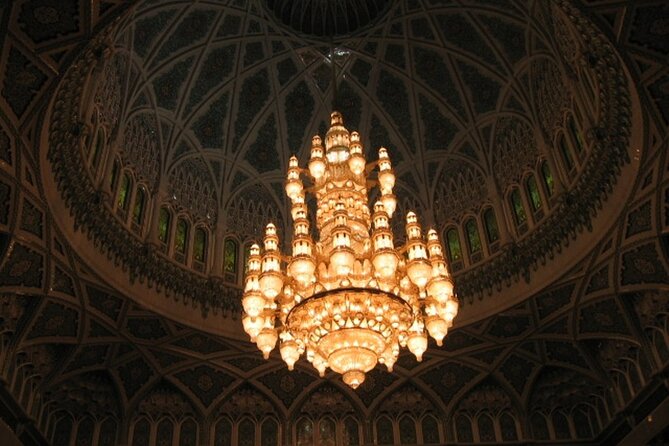
The details inside are the real reason to linger. The prayer carpet weighs 21 tons and uses 28 colors. The chandelier measures 14 meters in length and is made with Swarovski crystal. Those numbers can sound abstract until you see how much of the prayer hall they occupy.
You have about 45 minutes here, and admission is listed as free. That is enough for a focused look, though not an unhurried architectural study. If the mosque is your main reason for booking, ask your guide how the timing works on your date and set your expectations accordingly.
The mosque also gives you useful context for the rest of the day. Oman’s public architecture often favors clean forms, symmetry, and careful decoration rather than visual clutter. After this polished opening, the fish market and Mutrah Souq feel all the more grounded in daily life.
Al Qurum and the road toward Mutrah
The drive from the mosque is part of the city introduction. You pass ministries and embassies, then continue along the beach street in Al Qurum on the way to Mutrah.
This is not presented as a long beach stop. Instead, it is a chance to see how Muscat spreads along the coast and how official districts connect with the older port areas. I appreciate this kind of drive on a first day in a city because it helps you place the monuments on a map rather than seeing each one as an isolated stop.
The tour is private, so your guide can point out the transition between districts while you ride. Pickup is offered, and the tour is also near public transportation, though the private pickup is the more practical choice for a day with this many stops.
Mutrah Fish Market: an everyday view of Muscat
The fish and vegetable market lasts about 20 minutes. It is a short stop, but it supplies something the grand buildings cannot: a glimpse of local buying and selling.
Fresh fish and seafood are brought into the market, where local people pay for and sell the catch. The point is not a staged cultural show. You are seeing a working market, so the experience may feel more direct and less polished than the city’s formal attractions.
Twenty minutes should be enough to look around and take in the scene, but do not expect a long food tour or a detailed market visit. The stop works best as a brief, authentic pause before the shopping lanes of Mutrah Souq.
If you prefer monuments and museums, this may be the least important stop for you. I would still keep it in the day because it adds balance. Muscat is not only mosques, palaces, and forts. It is also a port city where seafood remains part of ordinary life.
Same coast and mountains, a completely different day out:
- Muscat: Daymaniat Islands Snorkeling Trip with Brunch
★ 4.7 · 2,317 reviews - Muscat: Wahiba Desert and Wadi Bani Khalid Guided Group Tour
★ 4.8 · 820 reviews - Muscat: Half-Day Sightseeing Essentials Tour and Audio Guide
★ 4.2 · 598 reviews - Muscat: Wadi Bani Khalid Oasis & Oman Desert Tour
★ 4.8 · 434 reviews
Mutrah Souq: one hour in old shopping lanes
From the fish market, it is a short drive to Mutrah Souq. You have about an hour here, and that is a sensible amount of time for a first look at Oman’s best-known traditional market.
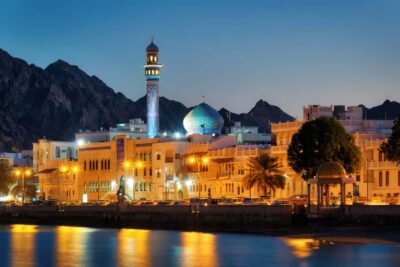
Mutrah Souq dates back roughly 200 years and sits beside Muscat’s harbor. Its location mattered during the age of sail, when ships moved between the Arabian Peninsula, India, and China. The market’s narrow lanes and crowded stalls are part of its character.
The name Mutrah is connected with the darker interior sections, where sunlight does not reach easily and shoppers need lamps to find their way. That detail helps explain the feel of the place. The souq is not a broad open plaza. It is a series of lanes where you move from one small shopfront to another.
An hour lets you browse without letting the market swallow the entire day. You can look at traditional goods, compare prices, and get a sense of how the old harbor district still functions as a shopping center. The tour description does not promise a shopping allowance or a specific list of products, so treat the stop as open browsing rather than a guided buying program.
I like this part of the day because it leaves room for personal choice. Some people will want to shop. Others will want to photograph the lanes, study the architecture, or simply enjoy a change from formal sightseeing. Your private format makes it easier to leave when you have had enough.
Mutrah Fort: views and defensive design
Mutrah Fort is reached from the souq and occupies a mountain ridge overlooking Mutrah and its bay. The position explains the fort’s purpose immediately. From above, it could help defend the port from attacks arriving by sea or from inland routes.
The fort is said to have been built as an Omani fort in 1507, after which the Portuguese added two towers and a curtain wall. Under the Al Busaidi dynasty, the curtain walls were doubled and more towers were added. The Ministry of Heritage and Culture restored the fort in 1980.
You have 30 minutes here, and admission is included. The stop is less about walking through a vast complex and more about understanding the fort’s position, towers, and defensive plan. Wear practical shoes if you want to make the most of the visit, though no specific footwear requirement is provided.
This is one of the better stops for seeing how geography shaped Muscat. The harbor, ridge, and fort are closely linked. If you have a strong interest in military architecture, half an hour may feel short. For a broad city tour, it gives you enough time to grasp the setting before moving on.
Bait Al Zubair Museum: culture in a compact visit
Bait Al Zubair Museum follows Mutrah Fort, with about 30 minutes allotted. The museum presents Omani culture and history, along with information about the Royal Family.
That makes it an important stop, but the short timing tells you how to use it. You are getting an introduction, not an extended museum afternoon. Focus on the displays that help explain Omani clothing, customs, objects, and royal connections, then ask your guide about anything that catches your attention.
A museum can sometimes feel detached from the streets outside. Here, its value comes from the sequence. You have just seen a working market, an old souq, and a defensive fort. The museum gives those places cultural context and helps connect the physical sights with Oman’s wider identity.
Admission is included. If museums are your priority, you may wish this stop were longer. If you want a broad introduction to Muscat without spending the whole day indoors, 30 minutes keeps the pace moving.
Al Alam Palace and old Muscat
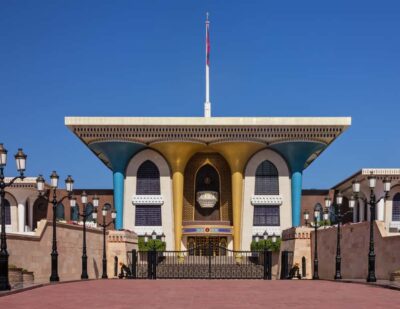
The route continues into old Muscat for a 15-minute stop at Al Alam Palace. The palace has a history of more than 200 years and was built under Imam Sultan bin Ahmed, described as the seventh direct great-grandfather of Sultan Haitham.
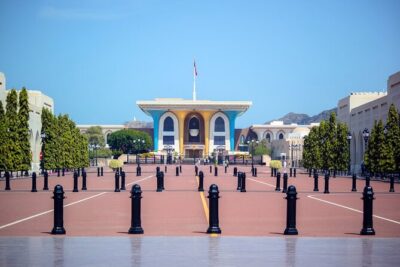
The present building was rebuilt as a royal residence in 1972. Its blue and gold facade gives it a distinctive appearance, but the palace is not open for interior touring. The inner grounds remain off-limits, while you can stop near the gates and take photographs.
That access detail is important. You are coming here for the exterior, setting, and royal district, not a palace tour. Fifteen minutes is enough for photographs and a short explanation, but anyone expecting rooms, galleries, or gardens open to the public should adjust plans.
I like the restraint of the stop. Al Alam Palace is elegant without being presented as an enormous showpiece. It also introduces old Muscat as a ceremonial center, a useful counterpoint to the commercial harbor district you saw earlier.
Al Jalali and Mirani Forts: photograph-only history
Just behind the palace are Jalali and Mirani Forts, built by the Portuguese under Philip I of Portugal in 1580 on an earlier Omani fortress. They were intended to protect Muscat’s harbor after Ottoman forces had sacked the city twice.
The forts later fell to Omani forces in 1650. During civil conflicts from 1718 to 1747, Persian forces captured them twice after being invited to assist rival imams. The structures were later rebuilt.
Your stop lasts about 10 minutes and is for photographs only. Neither fort is open to the public. This is a useful distinction because the dramatic position can make you expect an interior visit.
The short stop still earns its place. Seen from the palace area, the forts show how tightly military power and harbor control were linked in old Muscat. Think of it as a visual history lesson, not an attraction where you will climb towers or inspect rooms.
Royal Opera House: a modern Omani statement
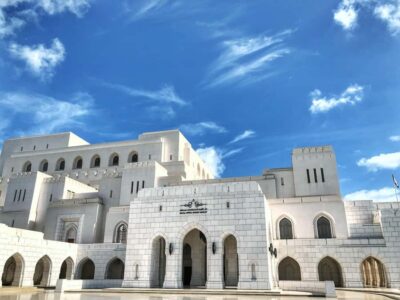
The Royal Opera House gives the day a polished final act. Sultan Qaboos bin Said Al Said, a supporter of classical music and the arts, ordered its construction in 2001. It officially opened on October 12, 2011.
The building reflects contemporary Omani architecture and includes a concert theater, auditorium, formal gardens, a cultural market, luxury restaurants, and an art center for musical, theatrical, and operatic productions. The main venue can accommodate up to 1,100 people.
You have about 30 minutes here, with admission included. That is enough to appreciate the architecture and the public spaces, but it is not the same as attending a performance. No concert or show is included in the tour details.
The opera house is a smart closing stop because it shows modern Oman without abandoning local design language. After the old forts, market, and palace, you see a country presenting itself as a contemporary cultural center.
What the $259 price means
At $259 per person, this is not a budget sightseeing bus. It is a private, full-day service with pickup offered, a dedicated group experience, and a route that covers many parts of Muscat.
The value improves if you are traveling with several people and can use a group discount. A private format also matters if you dislike waiting for strangers, want to ask questions freely, or need to keep the day focused around your own interests.
Admission is listed as free at the Grand Mosque, Mutrah Fish Market, Mutrah Souq, Al Alam Palace, and Al Jalali Fort picture stop. Admission is included at Mutrah Fort, Bait Al Zubair Museum, and the Royal Opera House. The supplied details do not identify separate costs for food, shopping, or any personal purchases, so budget for those independently.
The price is harder to justify if you only want the mosque, souq, and palace. You could spend less by arranging individual transport, but you would lose the convenience of a single organized route and the private guide. For a first Muscat day, the broad coverage is the main reason to pay more.
Timing, comfort, and practical limits
The tour starts at 8:30 a.m. and runs for roughly seven to eight hours. That is a long day, but the stops are varied enough to prevent the schedule from feeling like one extended museum visit.
Pickup is offered, and the activity is near public transportation. Since the route includes the Grand Mosque, Mutrah, old Muscat, and the opera house, having transport arranged is useful. The tour is private, so only your group participates.
The experience is not stroller accessible. The supplied information says most people can participate, but it does not provide detailed mobility guidance for every stop. If you have specific access needs, ask the operator before booking, especially because Mutrah Fort is on a mountain ridge and the souq has narrow lanes.
Weather also matters. The tour requires good weather, and a cancellation caused by poor weather can be moved to another date or refunded in full. For a customer cancellation, free cancellation applies when you cancel at least 24 hours before the start time. Changes made less than 24 hours before the start are not accepted.
The tour has a perfect five-star rating from four published reviews, including praise for friendly service and a well-organized day. That is encouraging, though four ratings are too few to prove how every departure will run. The clearest practical takeaway is that organization is one of the experience’s strongest selling points.
Who should book this Muscat tour?
I would choose this tour for a first visit to Muscat, especially if you want the main sights in one day and prefer not to arrange several rides. It also suits families or small groups that want their own vehicle and guide rather than a fixed large-group schedule.
It works well for architecture fans. You get a mosque, market, souq, fort, palace, museum, and opera house, each offering a different design language and purpose. It also suits anyone who wants both formal Oman and everyday Oman in the same day.
I would think twice if your priority is slow museum time, extensive fort exploration, or a long visit at the Royal Opera House. The schedule is broad, so most stops are introductions. You see a lot, but you do not linger deeply at every sight.
Should you book it?
Book this private Muscat City Tour if you want an efficient first-day overview, pickup, and a route that joins the Grand Mosque with the markets, forts, palace, museum, and opera house. The private format and strong praise for friendly, organized service add real value for a group.
Skip it if $259 per person feels too high or if you prefer to explore one district slowly. The tour’s strength is range, not extended time at each stop. For most first-time visitors with one full day in Muscat, that range is a sensible trade.
FAQ
How long does the private Muscat City Tour last?
The tour lasts approximately seven to eight hours. It begins at 8:30 a.m.
Is pickup offered?
Yes. Pickup is offered, and the tour is also near public transportation.
Is this a private tour?
Yes. Only your group participates in the activity.
Which attractions are included?
The route includes the Sultan Qaboos Grand Mosque, Al Qurum Beach area, Mutrah Fish and Vegetables Market, Mutrah Souq, Mutrah Fort, Bait Al Zubair Museum, Al Alam Palace, Al Jalali Fort picture stop, and the Royal Opera House.
Are the Al Jalali and Mirani Forts open to the public?
No. The forts are visited for photographs only and are not open to visitors.
What is the cancellation policy?
You can cancel at least 24 hours before the start time for a full refund. Cancellations or changes made less than 24 hours before the start time are not accepted, and poor weather may lead to a different date or a full refund.
Just added around Muscat
- Wadi Shab &Bimmah Sinkhole &Heart shaped Cave &Pebble Beach★ 5.0 · 5 reviews
- Wahiba Sands and Wadi Bani Khalid Full-Day Tour from Muscat★ 4.6 · 3 reviews
- Try scuba Diving Tours To Daymaniyat Islands.★ 5.0 · 12 reviews
- Watching Sunrise in Wahiba Sand Desert – Early Morning Tour★ 5.0 · 7 reviews
- Wahiba Sands&Wadi Bani Khalid desert Safari(Muscat tours)★ 4.5 · 6 reviews
- From Muscat Wadi Shab and Bimmah Sinkhole Tour★ 5.0 · 6 reviews
- Wahiba Sands and Desert Safari from Muscat★ 5.0 · 3 reviews
- Wahiba Sands&Wadi Bani Khalid desert Safari(Muscat tours) : Private tours★ 4.5 · 6 reviews
City Tours, compared.
Half-Day Private Muscat City Tour – Top Landmarks in Just 4 Hours
Read our review →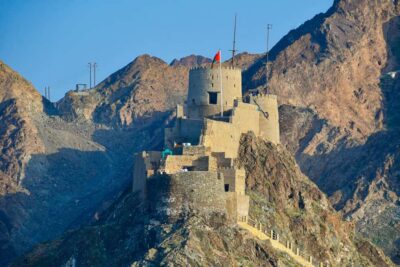

Half-Day Private Muscat City Tour- with a local guide
Read our review →Browse the lists this tour appears in