
Reviewed · CITY TOURS
Private Evening Muscat City Tours
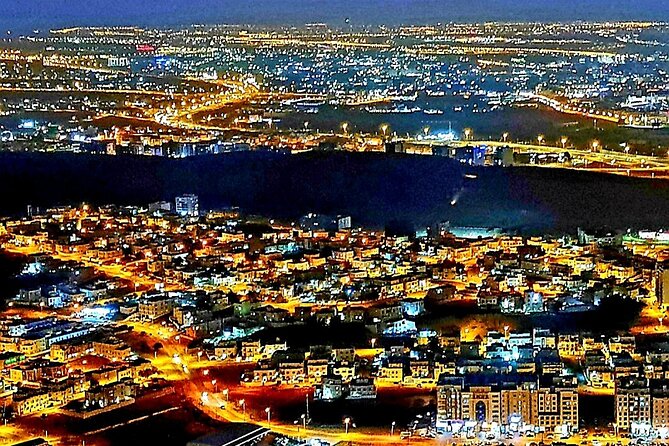
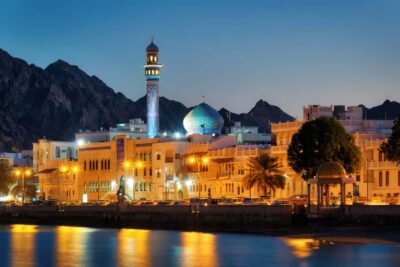
Muscat looks its best after the heat fades, when the Al Hajar Mountains turn dark against the Gulf of Oman and the city lights pick out its white buildings. This private evening tour gives you a fast look at the capital, from the Amerat road to the old harbor, with dinner at a local restaurant at the end.
I like the private format, since your own group sets the pace and you can ask questions without a busload of strangers waiting. I also like the mix of grand landmarks and ordinary Muscat life: glittering mosques and a royal palace are followed by the narrow shops and daily trade of Muttrah Souq.
The main catch is timing. Several major sights are photo stops only, and some venues are closed at night. If you want to enter the mosques or Royal Opera House, book a daytime visit instead, then use this tour for the cooler air and sunset views.
Five things worth knowing before you book
- The tour crosses several sides of Muscat: You move from Al Amarat and the southern suburbs to Qurm, Muttrah, and Old Muscat.
- Most landmark stops are exterior visits: The Mohammed Al Ameen Mosque, Sultan Qaboos Grand Mosque, Royal Opera House, and harbor forts are viewed from outside.
- Muttrah Souq gets the longest stop: Plan on about an hour to browse shops and absorb one of the city’s most local-feeling sights.
- Guides Khalid and Khalil receive special praise: Their English, local knowledge, driving, and easy manner are important strengths of the experience.
- Dinner is included in the evening flow: After the forts, you eat at a local restaurant before returning to your hotel.
- The $106 price buys privacy and convenience: It is easier to justify for a small group than for one person traveling alone.
Why an evening tour works well in Muscat
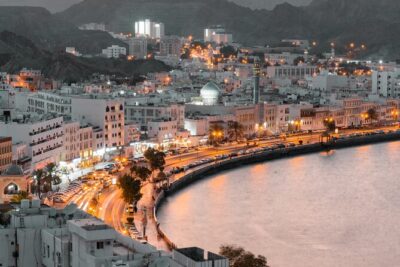
Muscat is spread out, not packed into one walkable center. The city reaches along the coast and between mountain roads, so a car-based tour saves you the trouble of arranging separate rides to distant sights.
The four-hour schedule is best viewed as an introduction, not a full cultural study. You will see the major symbols of Muscat, hear context from your guide, and get a feel for the city’s shape. You will not have time to linger inside every building or explore each neighborhood on foot.
The evening setting is a real advantage. Oman can be very hot, and the open-air parts of the tour are easier after sunset. The Muttrah Corniche is especially pleasant as the light fades across the mountains and the harbor.
Still, darkness changes what you see. Fine architectural details are harder to appreciate, and the tour cannot offer the same interior visits as a daytime outing. I would choose this experience on a first evening in Muscat, then return to one or two favorite places during daylight if your schedule allows.
A few more Muscat trips to weigh up
- Muscat: Omani Dhow Coastal and Sunset Cruise
★ 4.6 · 198 reviews - Muscat: Evening Guided City Highlights Tour by Van
★ 4.8 · 175 reviews - Private Watching Sunset Desert Safari Tour
★ 5.0 · 71 reviews
From Al Amarat to the marble domes
The first stop takes you toward Al Amarat, also called Al Amirat, in Muscat Governorate. You spend about 30 minutes in the area, with no admission charge.
This gives you a look at the wider city rather than only its postcard center. Al Amarat is a separate wilayat with its own civic offices, police station, municipality, and local administration. The road also helps show how Muscat sits between rugged mountains and the coast.
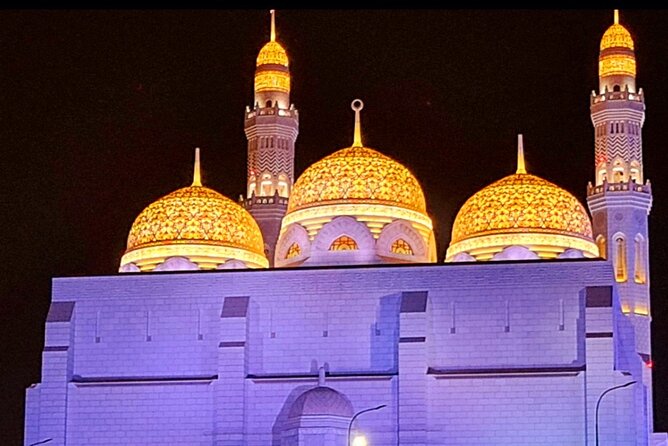
Next comes Mohammed Al Ameen Mosque, a 20-minute photo stop. Its marble exterior and large dome are especially striking from the road, even if you do not go inside.
The mosque was built between 2008 and 2014 on a site measuring 20,300 square meters. Its main prayer hall can hold 2,100 people. The chandeliers use gold plating and Swarovski crystals, with design and construction work involving suppliers from several countries.
Those interior details are interesting, but they are not part of the evening visit. You should think of this stop as an architectural picture break, not a mosque tour.
Sultan Qaboos Grand Mosque from the outside
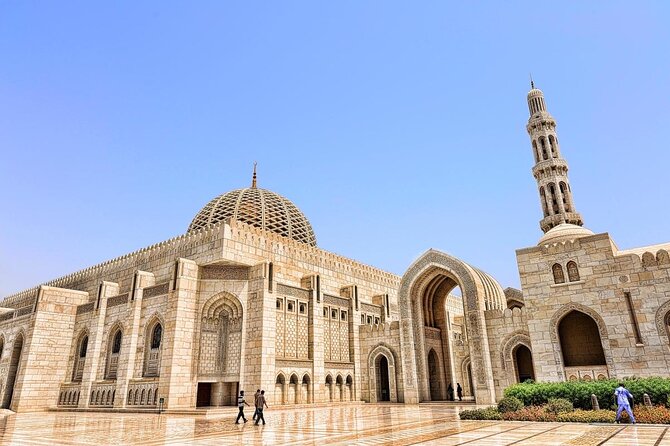
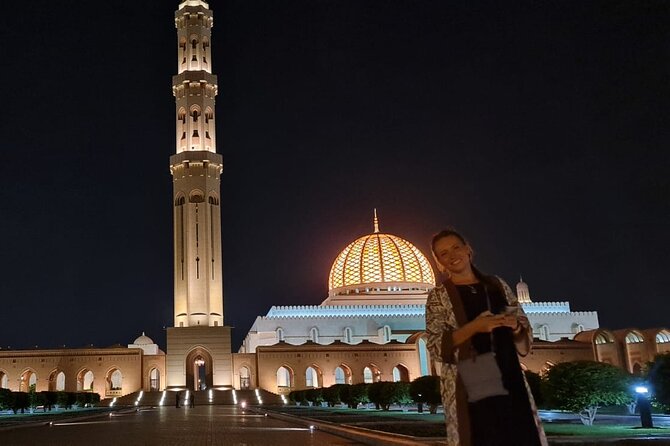
The Sultan Qaboos Grand Mosque is one of Muscat’s defining sights. Its square form surrounds a central dome, while five minarets represent the five pillars of Islam.
The main minaret rises 91.5 meters, and the four smaller ones reach about 45 meters. The main prayer hall holds more than 6,500 worshippers, with a separate women’s hall for 750. Outdoor paved areas can hold thousands more during prayer.
You get about 30 minutes here, again as a photo stop only. That is enough to admire the broad proportions and take photographs, but not enough for the quiet interior experience that makes a mosque visit memorable.
This is the clearest reason to consider a separate daytime visit. The night tour shows you the building lit against Muscat’s dark sky, while a daytime visit gives you access to the prayer halls and grounds when open. The two experiences serve different purposes.
The Royal Opera House and Muscat’s modern side
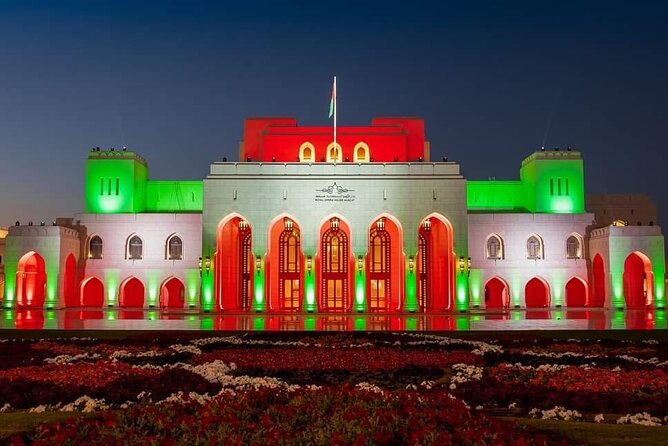
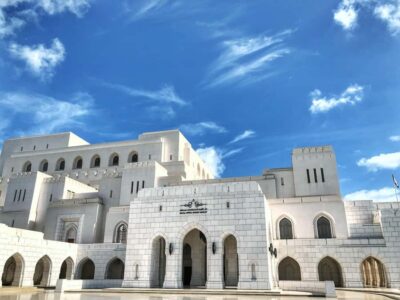
The Royal Opera House Muscat receives a 15-minute photo stop. It sits in the Shati Al-Qurm district on Sultan Qaboos Street and serves as Oman’s main venue for musical arts and culture.
Even from outside, it helps round out the picture of the capital. Muscat is not only forts, souqs, and old harbor walls. It also has polished cultural buildings and a modern public face.
Fifteen minutes is enough for a look and a few photographs. It is not a performance visit, and no show is part of the tour. If opera and concert architecture matter to you, check whether a separate daytime or evening program fits your dates.
Same coast and mountains, a completely different day out:
- Muscat: Daymaniat Islands Snorkeling Trip with Brunch
★ 4.7 · 2,317 reviews - From Muscat: Wadi Shab & Bimmah Sinkhole Full-Day Tour
★ 4.8 · 1,862 reviews - Muscat: Wahiba Desert and Wadi Bani Khalid Guided Group Tour
★ 4.8 · 820 reviews - Muscat: Half-Day Sightseeing Essentials Tour and Audio Guide
★ 4.2 · 598 reviews
One hour in Muttrah Souq
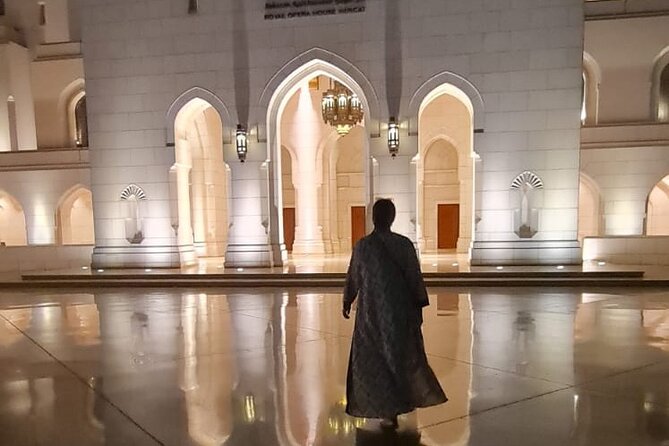
Muttrah Souq is the heart of this tour for anyone who likes markets. You get about an hour to walk through its covered lanes, browse shops, and watch the ordinary rhythm of buying and selling.
The souq is one of the oldest markets on the Arabian Peninsula, although its present building was rebuilt in the 1970s. A palm-frond roof was later added to give it a more traditional feel.
I like that this is not presented only as a showpiece for outsiders. The market serves local people as well as visitors, so you may find a more grounded atmosphere than in souqs built mainly for tourism. Shopkeepers may call for your attention, but the approach is described as less forceful than in the markets of more heavily visited destinations.
Use the hour well. You might look for Omani handicrafts, traditional goods, clothing, spices, or small gifts, but the supplied tour details do not promise specific purchases or tastings. Bargaining customs and payment methods are not stated, so ask your guide before making a larger purchase.
The guide can also help you understand what you are seeing. Khalid and Khalil are praised for clear English and useful local explanations, and that kind of help matters in a market where signs and products may not always be easy to interpret.
Sunset along the Muttrah Corniche
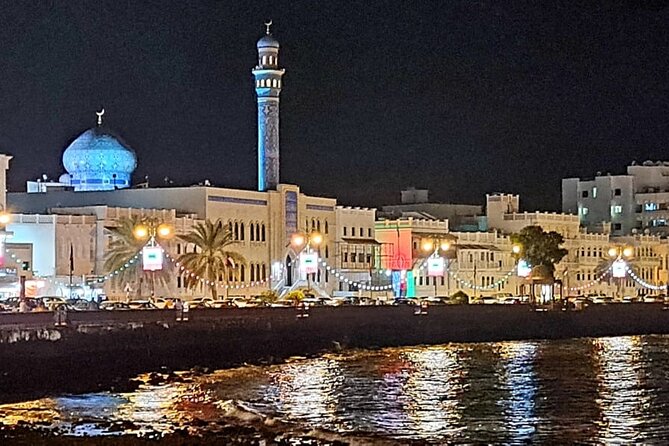
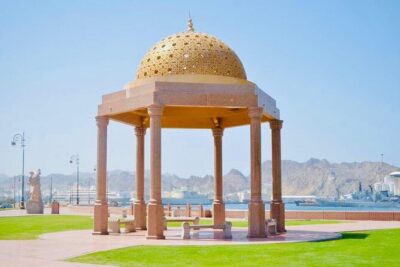
The souq opens onto the Muttrah Corniche, where you spend about 15 minutes. The waterfront is lined with latticed buildings, mosques, pavements, fountains, and mountain views.
This is one of the most photogenic parts of the evening. At sunset, the light cuts across the serrated mountains and throws shadows over the crescent-shaped bay. You get a brief stroll rather than a long waterfront walk, so keep your expectations in check.
If you want a slow promenade, this schedule will feel short. If you want a well-placed pause between the market and Old Muscat, it works nicely. I would save a few minutes for the view rather than spending every second inside the souq.
Old Muscat, Al Alam Palace, and the harbor forts
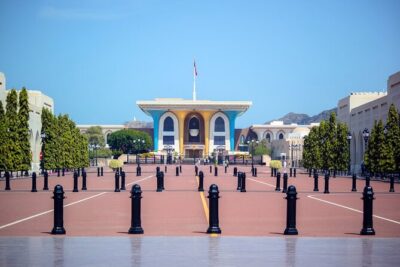
The route then moves into Old Muscat for Al Alam Palace. You have about 30 minutes here.
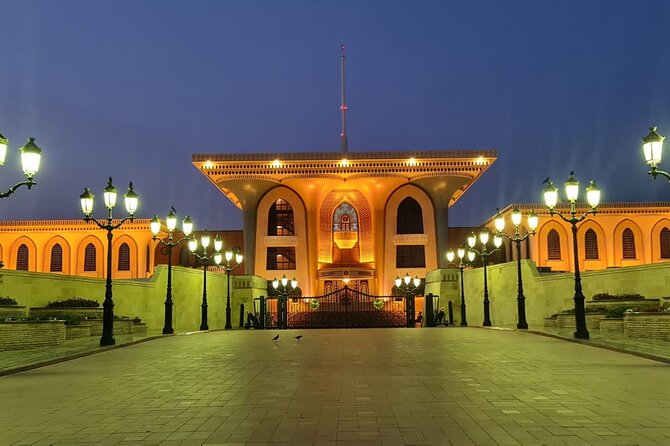
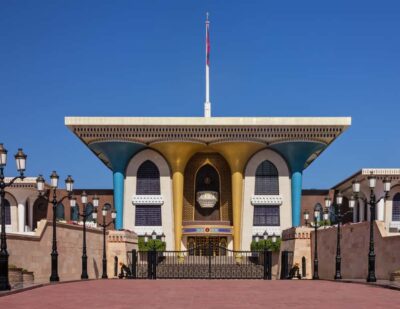
Al Alam means Flag Palace. Built in 1972, it is the ceremonial palace of the Sultan of Oman and an example of modern Islamic design. The palace is used for receiving important visiting dignitaries, while the Sultan lives elsewhere for day-to-day purposes.
You view the palace from outside. The setting is the main attraction: formal architecture framed by the old harbor and steep mountains. If the Omani flag is raised at the main entrance, the Sultan is present, according to the tour information.
The final stops focus on Al Jalali and Al Mirani forts, both seen from outside. Al Jalali takes about 10 minutes. The fort was built by the Portuguese in the 1580s on an earlier Omani stronghold, after Ottoman attacks had exposed the harbor’s weakness. Omani forces took it in 1650.
Al Mirani receives another 10-minute photo stop. The fort existed before the Portuguese period and was rebuilt by the Portuguese in 1587. It became the first fort in Oman to use cannons.
These forts are not open for an interior visit on this tour. Their value is visual and historical: they explain why Muscat’s harbor was so carefully defended and why the old city developed in such a tight space between water and mountains.
Dinner makes the evening feel complete
After the harbor forts, you eat at a local restaurant and then return to your hotel. The exact restaurant and menu are not specified, so you should not book this expecting a particular dish or dining style.
The meal does add something useful. After four hours of driving, photo stops, walking, and market browsing, you can sit down instead of arranging dinner on your own. The experience also includes a chance to sample local drinks and desserts, based on the feedback available about the tour, though the exact items can vary.
For many people, this is more practical than a sightseeing trip that ends at the last monument. You finish with food and a ride back to your hotel, rather than needing to find a taxi in an unfamiliar part of Muscat.
What $106 means in real value
At $106 per person, this is not the cheapest way to see Muscat. The value comes from privacy, pickup, a private vehicle, a local guide, and an arranged dinner over roughly four hours.
The price makes the most sense for a small group. Split among two or more people, a private tour can be a fair deal when you consider the time saved and the number of separate areas covered. For a solo visitor, the same price feels harder to justify unless convenience and personal attention are your main goals.
Group discounts are offered, but the amount is not provided. Ask for the current rate if you are booking with several people.
The tour is often booked about 22 days ahead. That does not guarantee a sellout, but it is a useful sign that you should not leave a popular evening date until the last minute, especially if your hotel stay is short.
The guide can make or break the route
A private city tour depends heavily on the person behind the wheel. Khalid is praised for being warm, well informed, and helpful, while Khalil receives praise for his English, explanations, and careful driving.
Those qualities matter here because much of the tour is viewed from outside. A good guide turns a series of quick stops into a connected story about Muscat’s mosques, royal buildings, market life, and Portuguese-era defenses.
You should feel free to ask for context during the drive. The route covers a lot of ground, and the guide’s explanations can help you understand why the city has no single dense center and how the old harbor relates to the newer districts.
The driving also matters. The tour includes roads between Al Amarat, the Grand Mosque area, Qurm, Muttrah, and Old Muscat. A calm, capable driver lets you focus on the scenery instead of the route.
Who should choose this Muscat tour?
I would recommend it to you if:
- You have only one evening in Muscat.
- You want a private introduction rather than a large group outing.
- You prefer seeing many major sights over spending hours inside one attraction.
- You want hotel pickup and a restaurant meal arranged for you.
- You are comfortable with exterior views and photo stops.
- You want a guide who can explain local customs and landmarks in English.
I would choose another plan if your main goal is entering the Grand Mosque, seeing the Opera House from inside, or studying the forts closely. The evening schedule does not provide those experiences.
Most people can participate, and only your group joins the activity. Confirmation is provided at booking. Free cancellation is available until 24 hours before the start time, while cancellations or changes inside that window are not refunded. Poor weather can lead to a new date or a full refund.
Should you book it?
Book this tour if you want a comfortable first look at Muscat, especially after arriving in Oman or during a short stay. The route gives you the city’s big visual markers, a useful hour in Muttrah Souq, a sunset waterfront stop, dinner, and a hotel ride home.
Skip it if you want a slow, detailed visit to religious buildings and cultural venues. In that case, use a daytime tour for the interiors and spend a separate evening walking Muttrah.
For most first-time visitors with limited time, I see this as a strong orientation tour rather than a final word on Muscat. The private setup, capable guides such as Khalid and Khalil, and sensible dinner finish give it good practical value, while the photo-only stops are the tradeoff you need to accept.
FAQ
How long does the Private Evening Muscat City Tour last?
The tour lasts approximately four hours.
What is the price of the tour?
The listed price is $106 per person.
Is this a private tour?
Yes. Only your group participates in the activity.
Is hotel pickup offered?
Yes, pickup is offered.
Is dinner included?
The route includes dinner at a local restaurant before you return to your hotel.
Can I enter Sultan Qaboos Grand Mosque during this tour?
The Sultan Qaboos Grand Mosque is scheduled as a photo stop only.
Can I enter the Mohammed Al Ameen Mosque?
The Mohammed Al Ameen Mosque is also a photo stop only.
Is the Royal Opera House an interior visit?
No. The Royal Opera House is visited as a photo stop only.
How much time is allowed at Muttrah Souq?
You have approximately one hour at Muttrah Souq.
What is the cancellation policy?
You can cancel up to 24 hours before the start time for a full refund. Cancellations or changes made less than 24 hours before the start time are not accepted for a refund. If poor weather cancels the tour, you will be offered another date or a full refund.
Just added around Muscat
- Wadi Shab &Bimmah Sinkhole &Heart shaped Cave &Pebble Beach★ 5.0 · 5 reviews
- Wahiba Sands and Wadi Bani Khalid Full-Day Tour from Muscat★ 4.6 · 3 reviews
- Try scuba Diving Tours To Daymaniyat Islands.★ 5.0 · 12 reviews
- Wahiba Sands&Wadi Bani Khalid desert Safari(Muscat tours)★ 4.5 · 6 reviews
- From Muscat Wadi Shab and Bimmah Sinkhole Tour★ 5.0 · 6 reviews
- Watching Sunrise in Wahiba Sand Desert – Early Morning Tour★ 5.0 · 7 reviews
- Wahiba Sands and Desert Safari from Muscat★ 5.0 · 3 reviews
- Wahiba Sands&Wadi Bani Khalid desert Safari(Muscat tours) : Private tours★ 4.5 · 6 reviews
City Tours, compared.
Half-Day Private Muscat City Tour – Top Landmarks in Just 4 Hours
Read our review →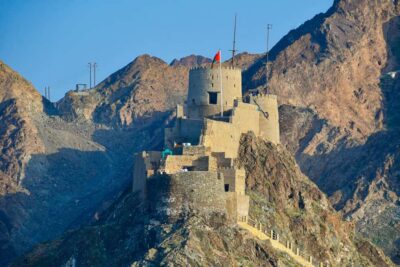

Half-Day Private Muscat City Tour- with a local guide
Read our review →Browse the lists this tour appears in